

I have been reading old books lately, and one of the unsettling things about them is how little they sometimes feel like old books.
I have been reading about America when Black men and women could be lynched while authorities looked away, when racial terror could become public spectacle and respectable people could convince themselves that the social order was basically sound. I have been reading about corruption, propaganda, nationalism, the fusion of Christianity with political power, and the gradual accommodation of churches to things they once might have recognized as evil.
I have been reading Bonhoeffer and Barth, Ellul and Stringfellow. Different countries. Different crises. Different decades.
And sometimes I have to remind myself that these words were not written yesterday afternoon.
They warned about the seduction of power, the sacralization of nations, the corruption of language, the manufacture of enemies, the ability of propaganda to make lies feel obvious, and the peculiar vulnerability of religious people to political idolatry. They warned about what happens when Christianity becomes useful to power and when the church becomes more concerned with preserving its place in society than bearing witness to Jesus.
And still we seem surprised.
Perhaps we misunderstand judgment because we expect it to arrive suddenly.
We imagine thunderbolts.
We imagine some unmistakable moment when God finally says, “Enough.”
But when I read the prophets, judgment often looks less like a lightning strike than a long, slow unraveling.
The warnings begin generations before the catastrophe.
Amos cries out against those who “sell the righteous for silver, and the needy for a pair of sandals” (Amos 2:6). Isaiah condemns those who “make iniquitous decrees” and “rob the poor of my people of their right” (Isa. 10:1–2). Micah speaks against rulers who “hate the good and love the evil” (Mic. 3:2). Jeremiah stands at the temple itself and tells religious people that their confidence in their sacred institutions will not save them while they practice injustice (Jer. 7).
The warnings continue.
Years pass.
Then decades.
Prophets come and go.
And still the people continue.
That may be one of the most frightening things about judgment: life can continue normally while a society is unraveling.
People still go to work. Markets open. Religious services continue. Politicians give speeches. Priests conduct worship. Families celebrate weddings. Children are born. People buy houses and plant vineyards.
The absence of immediate consequences is easily mistaken for vindication.
See? The prophets were wrong.
But perhaps judgment has already begun.
When Warning Hardens Rather Than Softens
There is another pattern in Scripture that troubles me even more.
Warnings do not necessarily produce repentance.
Sometimes they produce hardness.
The prophet speaks, and instead of asking, Could this be true?, people become angry at the prophet. They dismiss him. Mock him. Question his motives. Find another prophet who will tell them what they want to hear.
Jeremiah experienced this repeatedly. His message became so offensive that the king literally cut up the scroll containing his words and threw the pieces into the fire (Jer. 36:23).
The warning itself became intolerable.
And I wonder whether something similar happens to societies.
At first we are capable of being shocked.
Then we explain.
Then we rationalize.
Then we defend.
Then we celebrate.
What once would have troubled our conscience becomes normal. What once required an apology becomes a talking point. What once had to be hidden can eventually be done publicly and applauded.
The conscience does not usually disappear overnight.
It is worn down.
And perhaps this is why old books can be so disturbing. They prevent us from pretending nobody warned us.
They remind us that people saw these things coming.
The Watchmen Were Already Speaking
Bonhoeffer watched German Christianity accommodate itself to nationalism and racial ideology.
Barth recognized that when the church allows another authority to stand alongside the Word of God, something fundamental has already been surrendered.
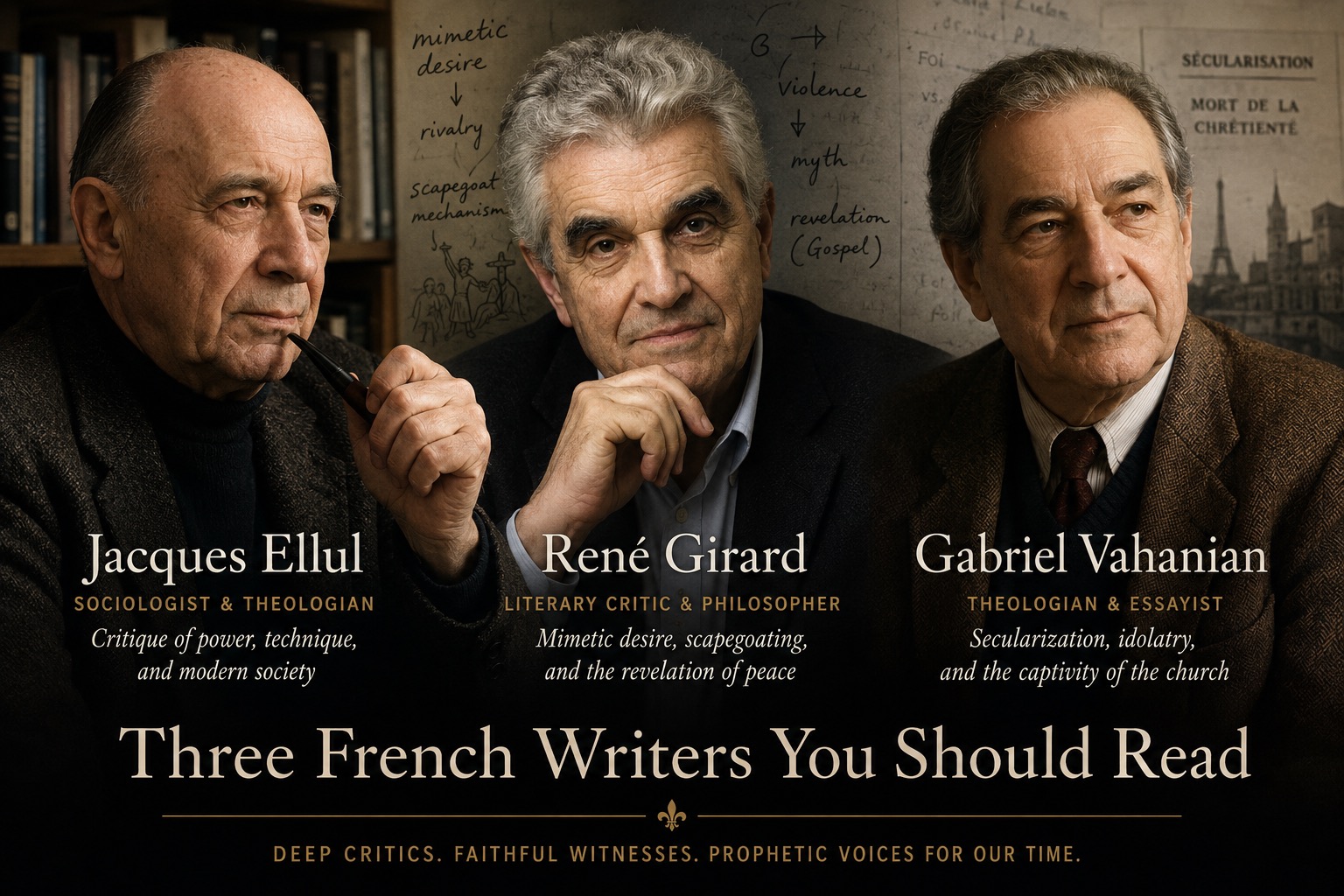
Ellul spent decades warning that propaganda works most effectively not simply upon ignorant people but upon people embedded in technological societies who consume enormous quantities of information and desperately need narratives that make the world manageable.
Stringfellow wrote about the “principalities and powers”—institutions, ideologies, nations, systems, and structures that promise life while becoming servants of death.
Their circumstances were different from ours, and we should resist simplistic historical analogies.
But that almost makes their warnings more disturbing.
Because they were identifying patterns.
And patterns recur.
The names change. The technologies change. The parties change. The slogans change.
Human beings do not change very much.
Neither does the temptation of power.
Perhaps This Is What Judgment Looks Like
Paul gives us a terrifying description of divine judgment in Romans 1.
Three times he says essentially the same thing:
“God gave them up.”
God gives them over to the desires they have chosen (Rom. 1:24, 26, 28).
That changes how I think about judgment.
Perhaps the most terrible judgment of God is not always that God sends us something we do not want.
Perhaps sometimes God gives us what we want.
We want power.
God gives us over to power.
We want enemies.
God gives us a world filled with enemies.
We want propaganda that confirms what we already believe.
God allows us to lose the ability to distinguish truth from lies.
We want leaders who tell us that we are righteous and everyone else is responsible for our problems.
God gives us the leaders we demand.
We want Christianity to bless our tribe, our nation, our grievances, and our ambitions.
Eventually we may be left with a Christianity that does exactly that—and can no longer recognize Jesus.
This is not God arbitrarily punishing people for breaking rules.
It is something far more frightening.
It is God allowing our choices to become our character and our character to become our destiny.
The punishment for worshiping power is eventually becoming a people ruled by power.
The punishment for embracing lies is eventually losing the capacity to recognize truth.
The punishment for cultivating hatred is eventually inhabiting a world in which everyone becomes an enemy.
The punishment for sacrificing conscience for victory is eventually discovering that we no longer have a conscience capable of telling us what victory has cost.
Judgment is the harvest of what we have planted.
The Long Mercy Before Judgment
But there is something else we should notice about the prophets.
The long delay of judgment is also mercy.
For generations God sends voices saying:
Turn around.
Remember who you are.
Do justice.
Stop exploiting the poor.
Stop shedding innocent blood.
Stop trusting in military power.
Stop confusing religious ritual with faithfulness.
Stop assuming that possessing God’s name means God endorses everything you do.
Return to me.
The fact that the warnings continue means the door has not yet closed.
Perhaps that is how we should read the voices that have warned us across our own history as well.
The abolitionists.
Those who confronted lynching and segregation while respectable Christianity defended or tolerated them.
Those who warned against nationalism and war.
Those who exposed corruption.
Those who warned the church about racism, propaganda, authoritarianism, consumerism, violence, and political idolatry.
Bonhoeffer.
Barth.
Ellul.
Stringfellow.
And many others.
We can argue with them. They were not infallible. They disagreed among themselves. Their historical circumstances were not ours.
But we should at least have the humility to listen.
Because one of the lessons of the prophets is that being warned does not mean we will listen.
Sometimes warning produces repentance.
Sometimes warning produces anger.
Sometimes the prophetic voice becomes one more thing we learn to explain away.
And eventually God says:
Very well.
Not because God has ceased to love.
Not because God delights in destruction.
But because love that never permits us to experience the consequences of our choices would cease to take our freedom seriously.
God gives us over.
And then what appeared to be a sudden collapse turns out not to have been sudden at all.
The foundations had been eroding for generations.
The warnings had been sounding for decades.
The compromises had accumulated one by one.
The things that once horrified us had become things we defended.
Then things we normalized.
Then things we celebrated.
And all along we mistook God’s patience for God’s approval.
Perhaps that is the question these old books are forcing me to ask.
Not, When will judgment come?
But:
What if the long, slow unraveling has already begun?
And perhaps the more important question is not whether we can predict where it ends.
It is whether, while there is still time to hear the warning, we are willing to turn around.



 Debbie and I serve as the FMI Global Associate Director for MENACA and Europe. We focus on cultivating disciples, leaders, and church planting movements.

